what adhesive to stop inground niche faceplate leaking
Pool leaks tin can be aggravating, peculiarly when y'all don't see any leakage, and don't know where to commencement. This postal service, originally from 2018 – is all new for 2020!
How do you know if your puddle is leaking? On a hot twenty-four hours, evaporation from a swimming pool can account for 1/4″ of pool water per solar day, and a good backwashing may use up to an inch of pool water. And maybe your aftermath line is leaking water or a loose plumbing fitting on the pump has a steady stream?
Splashout may exist a noticeable amount, if yous have a lot of pool activity, but not unremarkably. After accounting for these unavoidable leaks, if you still think your puddle is leaking – read on, my friend.
Is your Pool Leaking?
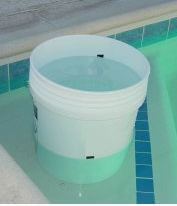 To remove evaporation from the equation, you tin perform a Bucket Exam on your pool. Place a 5 gallon saucepan on the commencement pace of your puddle, in a swimout, or on the top step of your ladder. Make full the saucepan half-full of water and mark the water level with a piece of electric record (or use a permanent marker) on the within of the bucket. With a 2nd piece of electric tape, mark the puddle water level on the exterior of the bucket. Avert backwashing and splashout for 24 hours, and compare the two marked measurements.
The water lost from the bucket will only be evaporation, simply the water lost from the pool is evaporation, plus (?) any other water loss. If in that location is a noticeable difference between the two, you can brainstorm to locate the leak in your puddle.
How to Find Leaks in your Pool
Leak detection in swimming pools is a step-by-step procedure of emptying amid 4 main areas; the Pool Shell, Pool Lights, Pool Plumbing and the Pool Equipment. Let'southward swoop correct in, shall we?
To find a puddle leak, the outset place to inspect is around your filter and pump. Do you notice any water spots or damp areas in that location? If then, try to trace dorsum where the water is coming from. Very often, it will exist a connexion on one of the pipes in this item area. You lot may need to plow on the pump for a while and observe it to see if any leaks develop while everything is running. However, a minor drip on the pump or filter will not amount to much, and is likely non noticeable in the pool level.
In order to determine whether or not the leak in the puddle is in the plumbing or in the crush of the puddle, you lot would isolate the plumbing. This ways to plug all the holes in the puddle. Plug the skimmer and the render fittings, cleaner fittings, vacuum lines, primary drain (if possible) with expandable freeze plugs or threaded plugs.
If no obvious leaks can be institute in the plumbing, then perhaps the leak is in the shell of the pool itself. If your pool is gunite, your plaster whitecoat is the water proof layer over top of concrete. Much tougher than a vinyl liner.
Leaks in your Puddle Shell
Vinyl pools have the most vulnerabilities in this area, with the potential for small tears in the vinyl, seam separations, or leaking effectually the cuts that were purposely made for the light, steps, skimmer, drains and wall returns.
Physical pools tin can leak through a scissure in the shell, near commonly in the tile line, or through small voids surrounding pipes that come through the wall, or the very common skimmer leak, at the interface of the plastic skimmer and concrete puddle wall.
Fiberglass pools tin can also leak through a crack in the beat like a concrete pool, or leaks in the skimmer, render, bleed or light faceplates.
 To detect or to rule out leaks in the pool shell, plug all of the plumbing lines – skimmer, chief drain, returns. You tin use rubber or threaded plugs – the kind used for winterizing. Close the pump off at the breaker, then information technology won't turn on while the lines are plugged. You may also desire to shock the pool beforehand, equally yous might need to proceed the pump off for a few days, if information technology keeps dropping. Heighten the h2o level to the normal level before beginning this examination, to prevent confusion – when the h2o has already stabilized at the everyman level.
Many times, if the leak is large enough, it will quickly driblet to, and stabilize at the problem area. This may be right at the bottom of the skimmer, or simply below the returns or at the pool light. If pool h2o level continues to drop with all of the lines plugged, you can dominion out the hush-hush plumbing (your worst fear). If however, the leak stops when you lot plug the pipes and shut off the pump, jump ahead to plumbing and equipment pool leaks.
When it seems that the h2o level has stabilized (remember that evaporation will continue unless you cover the pool completely with a solar blanket, and you will need to subtract any rainfall amounts), you lot can begin to audit the waterline area closely.
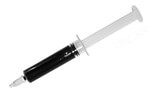 When your puddle vanquish or vinyl liner has a leak, commonly you volition find modest bits of debris that accept been sucked into the fissure or rip in vinyl. To confirm a leak in a suspected expanse, use food coloring or a dye syringe to dye examination the area.
Dye testing is done with the pump off, to reduce currents. Squirt a small amount of pool examination dye nigh the area to see if it moves towards and gets sucked out of a pigsty. Wearable a mask or goggles to see the action conspicuously.
Leaks in the Puddle Skimmer
One of the about common areas for leaks on an in-basis puddle, leaks can occur inside the skimmer trunk, or on the sidewalls of the skimmer, usually from wintertime freeze harm or excessive ground move. Aboveground pool skimmers are oftentimes replaced entirely when leaking occurs, due to their low price.
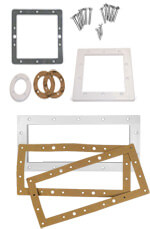 On vinyl liner pools, the faceplate and gasket are ever the first suspects and can exist dye tested, equally described above. Rust on the skimmer faceplate or vinyl liner tin can be a sign of a leak, causing rust to class on the pool walls, which tin can impairment the liner and walls.
If the wall area around the skimmer is rotted or rusted through yous tin use JB Weld to resurface a rusted wall, or y'all can use sheet metal to reinforce the area. Glue it and screw it, and and then tape the edges with duct tape.
Sometimes a vinyl pool skimmer leak is but a loose faceplate, check that all screws are [very] tight. Install vinyl puddle faceplates very tightly, using a #3 Phillips head until it squeaks and creaks!
Vinyl puddle wall and floor fittings all take two gaskets, ane under the liner and 1 higher up the liner. Replacing both faceplate gaskets is important, and be certain to use only OEM factory stainless steel faceplate screws if you demand replacements. Other screws may not tighten properly and can rust.
 On physical pools, look within the skimmer, to the point where the pool tile meets the forepart of the plastic skimmer. Inspect for cracks and debris stuck in the cracks. Dye testing volition confirm the leak, often found on one or more of the three sides shown in the moving-picture show, straight where the physical pool meets the plastic skimmer, which expand and contract at different rates, with fluctuating temperatures.
Yous tin also utilize food coloring or your pH reagent for dye testing suspected leaks. If using a test reagent from your examination kit, be sure non to suck in any water into the bottle, which will dilute the reagent and give fake examination results.
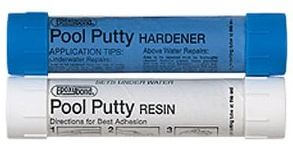 Cracks in the skimmer body (below the lid) can exist repaired with an underwater epoxy mix, normally sold as Puddle Putty. This tin too be used on the forepart three sides of the skimmer, where it mates with the concrete pool to fill in the voids and cracks.
To utilise Pool Putty, fleck out all loose or croaky material, mix equal parts of resin and hardener with a bit of pool water until a uniform colour. So whorl it into a 'serpent', and push the putty in place. It can be used underwater or above water.
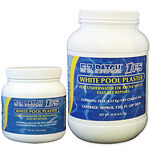 A second method for fixing inground physical pool skimmer leaks is to pack in new plaster at the interface of the plastic skimmer and the concrete pool wall, or tile really. Chip out old loose plaster where the tile ends and the plastic begins, and pack in new pool plaster mix to seal it up over again. Plaster mix is like shooting fish in a barrel to work with, just add water and stir to a spreadable consistency and place with a putty knife or trowel. EZ Patch ane can be applied higher up h2o or underwater, and pool plaster will cure underwater.
FIX-A LEAK: Nosotros sell a product chosen Fix-A-Leak, that is an emulsion added to pipes that seeks out and fills small cracks and voids. Information technology does work, on SMALL cracks and voids, but in my opinion, it'south better to observe and fix the skimmer leak. Where skimmer leaks are concerned, information technology's best to make a solid repair, and not rely on a product that may non work, or may simply work for a brusk time.
Leaks in the Pool Calorie-free
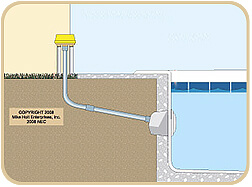 The conduit that carries the light cord from the low-cal niche to the light junction box is non sealed, and can become cracked from shifting grounds or freeze impairment.
If your pool water level has dropped down below the skimmer, below the returns and has stabilized at the top of the pool light, you probably have a leak in the pool lite conduit backside the puddle light.
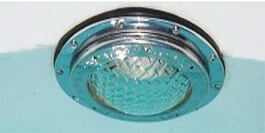 To repair, reach down and remove the screw at 12 o'clock and pull the light out of the lite housing, aka calorie-free niche. Pull the pool light over the pool coping and onto the puddle deck, or let it bladder in the water during inspection.
Conduit leaks are hard to dye test effectively, and so when a pool light is leaking, the common repair is to seal upwardly the opening where the light cord exits the niche and enters into the conduit.
In that location are three ways to seal up a leaking pool light conduit, and yous can do information technology underwater, without draining the pool, but if the h2o level is already low, it could be easier:
- With a golf-ball sized clamper of mixed puddle putty, create a mound around the cord as it enters the conduit. Push in and seal tightly confronting the cord. Permit to cure for 2 days with the lite on deck before replacing the light. Can be done underwater with a mask.
- With a tube of 100% Silicone , squirt upwards into the light conduit and around the end of the conduit to seal upward the exit for the water. Later a proficient silicone plug is made, allow to dry out for 2 days with the light on deck, before replacing the light into the niche.
-
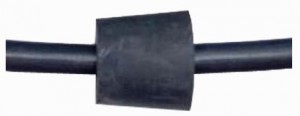 Employ a product chosen a Light Cord Stopper. This is a split prophylactic plug that fits around the cord; push information technology into the conduit where it makes a fast seal. This method is preferred for the reason that if you need to replace the lamp downward the route, y'all won't have to struggle with removing the putty, or silicone, which is especially hard to remove from the conduit.
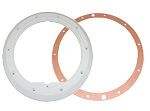 Vinyl puddle lights take a dual gasket seal and an outer faceplate band, and utilize ii calorie-free band gaskets, to sandwich the liner under the band and two gaskets. Vinyl puddle lights tin leak out of the conduit as described above, but may also exist leaking from a failed light ring gasket, or simply a loose light ring.
Other vinyl liner pool leaks tin occur on the main bleed gaskets, or step and swimout gaskets, and wall returns. You will need to lower the water to replace vinyl pool faceplate gaskets, or apply the NEMO underwater drill, only for fun!
If yous have a vinyl lined pool, small holes tin leak a lot of h2o. They are normally not too hard to notice even so. To locate a leak in a vinyl liner pool:
- Plow off pump and dye test around skimmer plate, and all wall fittings, underwater lights and drop in step, seat or spa sections.
- Inspect closely the corners of the pool, especially where the liner fits tightly. Wait for night spots or leaf debris stuck to the liner.
- Audit any ladders to brand sure ladder bumpers are in place and the ladder has not cut a hole through the pool liner.
- Expect for areas of the sand which appear to have washed away or eroded.
- Look for slight staining on the walls, which may point rust through.
When you lot find the leak in a vinyl liner, brand a skilful repair. If y'all can lower the water to the point of repair you volition get a meliorate bond. Employ a patch that is rounded, and is several times larger than the hole itself. Clean and dry out the expanse if possible and apply lite pressure for ane infinitesimal after patching, and so continue fussing with the edges to keep them from curling upwards.
Utilise Flexible Sealer to repair vinyl liner leaks. Or you can use a vinyl patch kit. The articulate patch cloth is piece of cake to piece of work with, but these tend to yellow over time, so a matching piece of your own vinyl is meliorate, if yous are fortunate enough to accept kept the pieces they cut out for the skimmer and the returns, or have a sample slice of your liner pattern.
Leaks in your Puddle Plumbing
If your pool has non leaked since you plugged all of the plumbing lines, that could indicate a leak in the underground plumbing. The thought of this can conjure up images of a backhoe operator ripping upward the pool deck, but it's never really that messy, and many times the problem pipe is easily accessed. Indeed, underground plumbing leaks are rare, but they can occur from deep freeze damage or extremely stiff shifting or expansive soils.
 A process of elimination tin also assistance determine which lines are leaking; Main Bleed, Skimmer or Returns. Leave the plug in your main drain and remove the plugs in the skimmers and returns to starting time up the pump. If it continues to leak, you can unplug the primary drain and replug the skimmers to cheque for skimmer leaks.
Puddle return pipe leaks lose more than water when the pump is running and pipes are under pressure; whereas a puddle suction line leak will pull air into the pump while the pump is under a vacuum, and leak more water when the pump is off.
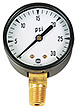 Pressure testing private plumbing lines tin exist performed to determine which line is leaking. Then, the leak can be pinpointed further with more avant-garde detection tools, which "mind" for the leaking. A leak detection specialist will then literally draw an "X" on the deck or on the dirt, and tell you to "dig hither". A 3'x3′ deck section can be cut out, then the clay removed to expose the pipage so that a repair can be fabricated, and the deck replaced.
Don't worry, your worst fears will probably not come up true. Many pool plumbing leaks are plant straight below where the pipe enters the ground, at the 90 plumbing fixtures, or tin be reached by tunneling a few feet under the deck, or found nether soft dirt, close to the equipment pad.
Leaks in your Pool Equipment
This ane should be pretty obvious to you. In about cases, y'all will see water running out of your pump, filter, heater or chlorinator. Could be a quick gear up or it could crave some equipment repair or replacement.
 One affair it won't be is equipment that is slowly baste-baste-dripping. Small drips on the equipment pad are not noticeable in the pool water level, and amount to a very pocket-sized amount of h2o loss. Even if yous have a fast drip, or several drips – it's likely less than l gallons per solar day, or nether 1/8″ of water level in the average pool.
 A leaking filter valve, on DE and sand filters, can become without notice if a aftermath hose is constantly connected to the waste material port. At some indicate, the spider gasket in a multiport valve will neglect, and after backwashing, h2o volition continue to stream slowly out of the waste port and out of the backwash hose. The aforementioned problem can occur if you have a push-pull type of slide valve. Missing plungero-rings will allow water to constantly menses out of the backwash line.
Plugging the backwash line can stop the flow of water while yous order the parts for the repair, only don't make this a permanent solution. Oh, and installing a slice valve on the waste line? Not a repair I'd be proud of; better to go inside the valve and fix the gasket / o-ring trouble.
In most cases, leaking pools are fixed easily. Don't continue yourself up at night with worst case scenarios, outset with the bucket exam and proceed through these stages to find your pool leak. If it does plough into an underground plumbing problem, you may demand to contact a leak detection expert to help pinpoint the leak – but most puddle leaks are not plant in the plumbing, but are one of the simpler types mentioned above.
Pool Leak Detection Tools
- Pressure Testing Equipment; h2o, air or gas
- Dye Testing Equipment; leak detection dye
- Sonic Testing Equipment; hydrophones and geophones
- Electronic Testing Equipment; LeakTrac 2200
Reasons to Fix Puddle Leaks
Pool leaks not but waste matter your precious treated and heated pool water, but could lead to other problems such as rusted pool walls, or erosion of a sand puddle floor or the supporting soil beneath your pool deck or pool equipment pad.
Happy Hunting! Leave me a reply below for questions not covered above!

Davy Merino
InTheSwim Blog Editor
Source: https://blog.intheswim.com/pool-leaks-how-to-find-them-and-fix-them/
0 Response to "what adhesive to stop inground niche faceplate leaking"
Enviar um comentário