what to look for in a residential investment in this stage of the cycle
I've often said that until you take invested through a total belongings investment wheel, you lot won't fully appreciate how the real estate market really works.
And so if y'all're a lilliputian confused nearly what's currently happening in our belongings markets and dandy to understand what's going to happen to the value of your home or investments, I'm going to share with y'all what you need to understand about property cycles.
You come across…though information technology's often said that the value of well located majuscule metropolis backdrop increase by almost vii – 8% each yr in Commonwealth of australia, this obviously is not abiding each and every year.
Looking at the chart below using Corelogic data you can run into that values tend to rise in waves.
In some years at that place will be stiff growth and in others there volition be no growth and in every property cycle there are times when belongings values fall.

Understanding the holding cycle
While many commentators refer to a vii year property cycle to explain how house prices oftentimes move through four phases, these cycles vary in length and aren't really dependent on a length of time, but more on a range of socioeconomic factors.
A simplistic version of the cycle looks like this…
Every bit our population grows, in that location is an increased need for real manor – both for rental properties from investors and new homes from owner-occupiers.
Slowly, this causes property values to increment because of the forces of supply and demand.
At the same time, builders and developers hop on board and kickoff constructing new dwellings to see this increased demand.
Nonetheless, the pendulum tends to swing too far and over fourth dimension nosotros usually terminate upwardly with an crowd of dwellings.
This oversupply tin eventually result in slumping dwelling values and hire reductions.
Looking back over recent decades, property growth in Australia has peaked in the following years: 1981, 1987, 1994, 2003, 2010 and 2017 , then it's easy to run across why some people feel property cycles last vii years.
And excavation deeper into the stats, it is clear that over the by 40 years, well-located capital urban center properties have seen their values double every 10 years or and then (growing at around 7% per year on boilerplate, according to the Real Estate Plant of Australia.)
Withal, at some stages of the cycle values increase, and at other times they stay flat or decrease.
And while near cycles practice seem to last betwixt seven and 9 years, the length of a detail property cycle tin can be affected by a combination of factors and influences such as the state of the economy, as well as social and political issues.
Then. at times, our regulators lengthen or shorten the cycle by irresolute economical and tax policies, while the RBA manipulates involvement rates to either encourage or discourage borrowing and spending.
The post-obit chart shows the very close relationship between finance approvals (brought forward to 6 months) and business firm prices.

The following graph shows an example of what could happen to house prices over two belongings cycles.

Each country is at its own phase of its own cycle?
While many people generalise about "the property market", at that place are many submarkets around Australia.
The fact is, each state can exist at a different phase of its ain property cycle. Even within each state, the markets in different areas are segmented by geography, price points and type of property.
For example, the "superlative-tier" more expensive end of the market will tend to perform differently to the new home heir-apparent'south market, which is different again from the investor segment or the established property sector.
While dissimilar states are usually at dissimilar stages of their ain cycles, this fourth dimension around things are different.
In Oct last year, as we were still coming to grips with coronavirus, all our property markets started booming. Well…all markets other than inner-city high-rise apartments.
This bicycle was led past property values in regional Australia rising strongly, as well as commencement home buyers taking advantage of many grants and incentives available, driving the cheaper stop of our property markets.
Now, the more than expensive end of the holding markets in our capital cities are amongst the stronger segments and exhibiting boom time levels of capital growth.

Here's how a belongings bike develops
A really simplistic version of the bicycle goes something similar this…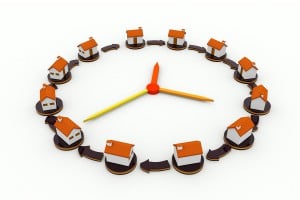
As our population grows (and boy was it growing strongly until we locked ourselves in a Coronavirus Cocoon) in that location is an increased demand for real estate – both rental backdrop and new homes from owner occupiers.
Some people buy new homes while others get started in existent estate investment.
Slowly this causes property values to increase because of the forces of supply and need.
At the same time builders and developers hop on board and start constructing new dwellings to meet this increased demand.
Nevertheless the pendulum tends to swing too far and over fourth dimension nosotros tend to become an crowd of dwellings, in part because of the long belongings evolution cycle. Merely look at all the apartments coming out of the basis at present!
This oversupply eventually results in slumping home values and rent reductions equally we're currently seeing in the Sydney and Melbourne property markets .
Yep…despite what many agents will tell you lot, existent estate values practise fall and often accept.
The good news is all belongings slumps are temporary, while the long term escalation of property values in our 4 big capital cities is permanent.
So how long do holding cycles last?
Putting a timeframe to these cycles is not easy.
Looking back over recent decades, belongings growth in Commonwealth of australia has peaked in the following years: 1981, 1987, 1994, 2003, 2010 and 2017 , and then it'south piece of cake to see why some people feel belongings cycles last seven years.
And digging deeper into the stats, it is clear that over the past 40 years, well-located capital city properties have seen their values double every 10 years or so (growing at around vii% per year on average, according to the Existent Estate Institute of Australia.)
However, at some stages of the cycle values increase, and at other times they stay flat or decrease.
And while nearly cycles do seem to terminal between seven and 9 years, the length of a item property cycle can be afflicted past a combination of factors and influences such as the state of the economy, too every bit social and political issues.
Then, at times, our regulators lengthen or shorten the bike by changing economic and taxation policies, while the RBA manipulates involvement rates to either encourage or discourage borrowing and spending.
The following chart shows the very shut relationship between finance approvals (brought forwards to 6 months) and house prices.
It's of import to realise that at some stages of the cycle values increment and at other times they stay flat or subtract.

Equally shown in the graphic in a higher place, at certain stage in the wheel property values exceed the underlying long term tendency (such as in boom times) and at other stages they fall short of this long term intrinsic value (such as during property slumps.)
Yes… the pendulum always swings as well far in the world of property investment.
History shows that the belongings cycle consistently passes through 4 phases:
 © 2007 -2021
The BOOM Stage
This tends to be the shortest phase of the bike.
During the boom real estate prices increase rapidly – often by more than twenty% per annum.
Recollect Sydney property in 2015-17?
Only look what'due south happened to property values in 2021 – many locations will exhibit growth of more than 20% this year.
While dwelling house buyers (who make upward around 70% of homeowners and buyers) underpin our property markets, it'south investors who create our property booms.
That's because each boom brings a whole new generation of investors into the market, driven past property seminars, the printing, Television shows and the like.
At the aforementioned fourth dimension as homeowners push up demand for houses and together this leads to increasing property prices.
Greed starts to kick in, as does speculation.
Often potential investors who tin't really afford to buy property extend themselves and speculate.
Some even buy "off the programme" hoping to sell at a profit, expecting prices to proceed rise.
At this stage of the bicycle banks ofttimes encourage investors with easy credit, sometimes lending them 80, 90 or even 100 per cent of the price of their investment backdrop, causing some to over-commit themselves financially.
Fear too drives property booms equally investors see property prices going upwardly all around them.
They are worried that they may miss out on the profits the boom has delivered to other investors.
During real estate booms you'll often find them willing to negotiate to buy at considerably in a higher place the asking price at a fourth dimension when sellers keep racking upwards their expectations as they observe the high prices accomplished for neighbouring properties.
Non agreement the dynamics of a property bike, many of these beginning investors become overconfident at a time when they probably should be the most cautious and they are prepared to overpay only to get into the belongings market, pushing up belongings prices to levels that are (in the short term at to the lowest degree) unsustainable.
Vendors also become greedy pushing up asking prices and this just feeds the property boom.
As the boom moves on many builders and developers alluvion the market with new properties to meet the increasing demand from owner occupiers and investors, but invariably they eventually flood the market with too many properties.
In general, booms are stopped when the Reserve Depository financial institution (RBA) increases interest rates to tedious downward the economy, and in the past it's been quite effective at doing this.
More recently (in 2014-18) the Australian Prudential Regulation Authority (APRA) has made the banks tighten their lending criteria to investors to deliberately ho-hum a market that information technology judged to be overheated.
Each tiptop is accompanied by a chorus of voices who deny the top is anywhere in sight and it'due south impossible to predict with whatsoever accuracy the moment when the bike turns, however a peaking property market is likely to take several of the following characteristics:
- Property values have risen strongly for a number of quarters
- Auction clearance rates are at high levels indicating a strong sellers' market.
- High levels of credit growth take occurred because consumers are borrowing more
- Banks' lending criteria have loosened and there are lending instruments. In the concluding big boom, no–doc and low-doc loans proliferated assuasive almost anyone to get a loan to buy belongings
- Builders and developers become over-confident and a high level of construction leads to an crowd of properties and higher vacancy rates
- Housing affordability becomes stretched
- Speculation is rife with a new generation of investors getting involved in holding hoping to "get rich quick"
- The RBA tries to dampen speculation by raising interest rates
- A credit crunch occurs and banks tighten their lending criteria.
The DOWNTURN PHASE
Booms are e'er followed by a downturn or slump phase that is often characterised by an oversupply of properties due to the over-exuberant activeness of builders and developers during the preceding boom.
This causes increasing vacancy rates and decreasing rentals.
Property prices end growing and sometimes drop past around 10 or then%.
This phase lasts a number of years, merely prolonged booms are commonly followed past a longer and deeper slump phase with a greater likelihood of prices falling further.
During the slump, property is out of favour in the media and investors frequently struggle with decreased greenbacks flows, higher interest rates and stalling values.
This is the time many inexperienced investors consider selling their properties.
However, when they do this in a falling market with few willing buyers, they exacerbate their problems and crystallise the loss in value of their backdrop.
Near the end of this stage of the cycle interest rates slowly drop every bit the RBA tries to stimulate consumer conviction and the economy, considering the prevailing sentiment is oft fright and desperation.
Effectually this time the banks becoming more "investor friendly" and start loosening their lending criteria.
The STABILISATION Stage
Somewhen the market place moves on.
Falling interest rates, rising rents and pent up demand during the slump phase set the stage for the next holding upturn.
But prices don't of a sudden start escalating wildly.
The downturn is usually followed by a period of time when buyers tentatively move dorsum into the marketplace soaking up the properties for sale, only every bit the number of buyers and sellers is in rough equilibrium, property prices remain flat or only movement upwardly slowly.
This is a time of smashing opportunity, however it is not easily recognised by most investors, despite it still being a heir-apparent's market.
The UPTURN Phase
In time the cycle moves on and eventually nosotros move into the upturn phase when vacancy rates slowly autumn, rents beginning to ascent and property values begin to increase.
At this stage of the cycle property is generally affordable, returns from property investments are bonny and domicile buyers and smart investors brainstorm to enter the market.
This is obviously a cracking time to buy belongings and while professional investors accept advantage of the opportunities in the upturn stage, many beginner investors accept longer to be convinced that property is a skillful investment.
However, this is a time of cracking opportunity to go set up for the property smash that will eventually follow.
This is also when many builders and developers brainstorm work on new development projects, aiming to accept them completed past the belatedly upturn or boom phases of the bicycle.
At the beginning of the upturn phase of the property cycle interest rates are commonly depression and it is easier to become finance.
As the upturn phase rolls on (remember this stage could last 3 or four years) more than investors and first-habitation buyers enter the market as conditions seem more favourable.
They come across property values increase and are concerned that they may miss out if they don't buy a holding.
While property values increase, they tend to do so much more gently than the "heady" price rises of the nail phase, which is just around the corner.
At the end of the upturn phase real manor prices will take risen substantially and property starts to become less affordable to many Australians.
And…..we start all over again.
The bottom line
At present nosotros are in a property boom, with capital city housing values likely to feel strong double-digit growth this year.
And property price growth is probable to continue well into 2022 and even into 2023, when eventually affordability will slow down our markets.
However, each boom sets united states upwards for the next downturn, just as each downturn sets the scene for the next upswing.
The good news is property slumps are merely temporary, while the long-term escalation of property values in our capital cities has been more than permanent.
Source: https://propertyupdate.com.au/understanding-property-cycles/
0 Response to "what to look for in a residential investment in this stage of the cycle"
Enviar um comentário